Studium UI/UX Design
Industry
Ed-tech
Timeline
Jul 2023 - Jun 2024
Organization
Studium Tech
My Role
UI/UX Designer
Team
1 Product manager, 2 Expert advisors, 2 Developers, 2 Customer success executives
Type
Live project
Description
Studium is a B2B SaaS platform for University Accreditations. Studium's Accreditation product is a complex, enterprise-grade product used by colleges & universities as a helping hand in their accreditation processes. My job at Studium included working through the entire design process on the multiple products, which included conducting thorough domain research by understanding documentation & discussing with domain experts, designing the information architecture and UX, designing interfaces and testing the completed modules.
Note: Product screens are not displayed due to confidentiality & company IP restrictions.
What the Accreditation landscape looks like…
Colleges face significant challenges in obtaining accreditation due to the complex and time-consuming nature of the process. Managing extensive documentation, ensuring compliance with stringent standards, and co-ordinating across multiple departments creates a daunting task. This often leads to inefficiencies, stress, and delays, making it difficult for institutions to achieve and maintain a decent accreditation status. The executive heads at these institutes are incentivized by research grants and tax deductions to comply with accreditation norms.
User Personas
The Professor
Age: 40
Role: Associate Professor
About: Sandeep is an Associate Professor responsible for teaching, mentoring students, and contributing to administrative responsibilities. With his institution preparing for the upcoming NAAC accreditation, he has been assigned documentation and compliance tasks in addition to his academic workload.
Goal: Complete accreditation-related tasks accurately & on time & spend more time on teaching & research.
Pain points: Accreditation guidelines are lengthy and difficult to interpret, with documentation is scattered across multiple files and departments.
Behaviour: Relies on spreadsheets, documents, and email for coordination.
The Director
Age: 60
Role: Director, Engineering Institute
About: Nikhil is the Director of a large engineering institute responsible for academic quality, regulatory compliance, institutional growth, and strategic planning. With the institute preparing for its first NBA accreditation cycle, he oversees the overall accreditation process while ensuring minimal disruption to day-to-day operations.
Goal: Achieve a successful accreditation outcome & also increase admissions.
Pain points: Limited visibility into progress across departments, difficult to track ownership, deadlines & pending tasks.
Behaviour: Reviews high-level progress rather than operational details.
Challenges faced by the stakeholders

How might we make the accreditation guidelines simple to understand for college faculty, staff & management?
How might we reduce faculty time spent on accreditation tasks?
How might we streamline collaboration across institutional hierarchies?
How might we provide real-time visibility into accreditation progress and improvements?
Insights from interviews

Faculty & staff were already doing the accreditation work manually. Going back & forth for data, using spreadsheets & local storage.
Faculty members looked at accreditation as a burden & wanted to focus on their daily teaching & research activities instead.
Institute management rarely knew if they were ready to go for an accreditation cycle, or how much would they score based on their current status.
What we set out to do…
Eliminate the need for faculty to study complex accreditation documentation.
Support multiple accreditation frameworks and institutional levels.
Automate report generation from collected data.
Generate actionable insights to improve accreditation scores.
Enable quick and accurate data entry for all accreditation criteria.
Streamline accreditation by providing supporting productivity modules.
Provide real-time progress tracking for all stakeholders including top management.
Track institutional improvements across accreditation cycles.
From blind spot to full picture
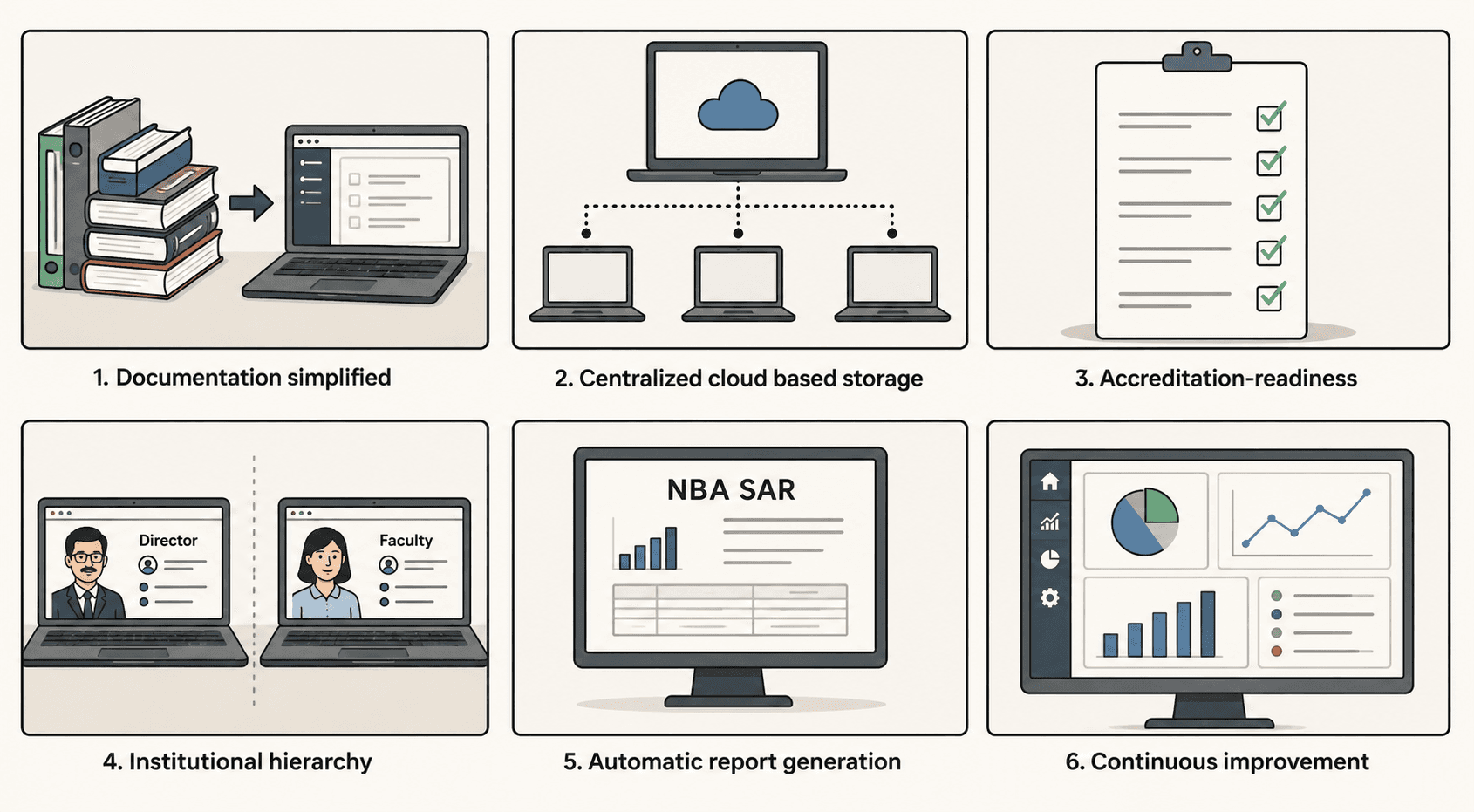
Our design solution made the users' work easy:
Documentation simplified: Each criteria & sub-criteria page clearly displayed the text, data, images or documents to be uploaded in the criterion. Actual accreditation documentation could be vague & leave users guessing what the requirements are.
Centralized storage: Centralized & shared cloud storage across all accounts in the institute meant no back & forth with peers for data. We linked our LMS data to the relevant accreditation criteria, allowing direct import of data. Users could now also upload using standard data sources like Excel, Google Sheets or Drive.
Accreditation-readiness: The platform now tells the institute whether they're ready to go for a certain accreditation & also how much they'd score based on their current scenario. This helped the management make crucial decisions & strategic plans.
Institutional hierarchy: The platform supports all levels like super-admin, criteria admin, regular faculty, etc. for all levels in the institute. Each type of account intended to be used for different purposes across the institute along with features like individual access control for CRUD operations.
Automatic report generation: Once all the data was filled in, one click report generation gave you a ready-made SAR or SSR in the prescribed format which you could submit. This saved a ton of time in compilation & formatting work.
Continuous improvement: Analytics using your institute's data transcended accreditation cycles. Detailed dashboards & reports highlighted insights into what you can do better to score more marks next time.
What challenged & shaped me
The user & the buyer of the product were different in our case, the top management being buyers but IQAC & faculty being the daily users. Designing a product that adds value to both the stakeholders taught me design as well as business.
Building habits through UX: Accreditation bodies ask for 3 to 5 years of data for a single cycle. Institutes are rarely prepared for this. I saw countless institutes struggling to find backdated data during their last year. Through UX we tried to build a habit to store data in the system in real-time so there's no rush at the very last moment.
Bridging the gap between multiple accreditations: Many different accreditations request overlapping data, so we had to figure out how we can save time by letting users store data once & use it for multiple accreditations.
Impact that we had…
Faculties reported spending less time studying documentation & more time teaching.
Entire accreditation workload decentralized & distributed evenly.
No duplicate work for multiple different accreditations.
No manual formatting & compilation work to make final reports.
Management understood their accreditation-readiness & areas for improvement before the actual cycle, giving them a chance to improve.
